Beets, Greens, Cocoa and Pomegranate: The Blood Pressure Claims, Checked
Beet, spinach, cocoa and pomegranate drinks get passed around with big promises attached for men past forty. Here is what each claim says, what the trials actually measured, and how much of it reaches a home glass.
By Wes Hadley ·
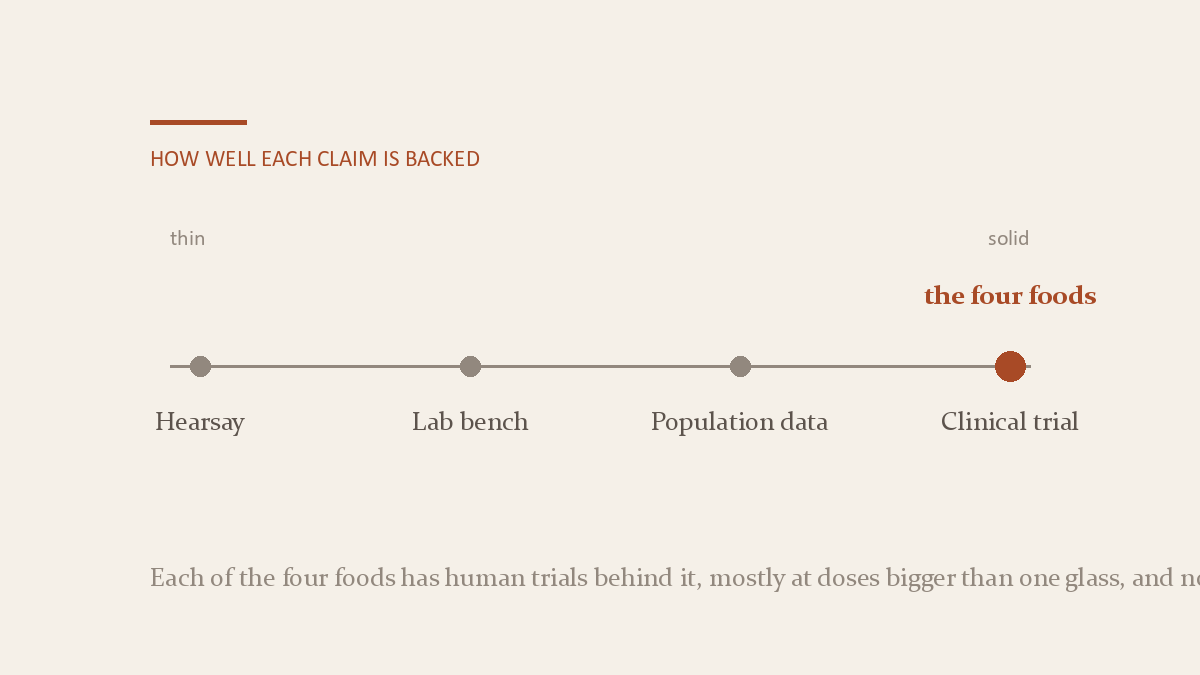
People send my beet and cocoa smoothie around, and it usually travels with a caption I did not write. Some captions are fair. Some promise more than any glass of anything can deliver. So I went back to the studies behind each ingredient and wrote down what was measured, at what dose, and in whom.
Two terms come up again and again. Nitric oxide is a gas made by the thin lining of your blood vessels; it tells the muscle in the vessel wall to relax, which lets the vessel widen. Flow-mediated dilation, or FMD, is an ultrasound test that measures how much an artery in the arm widens after a cuff is released. A higher FMD number means the artery responded better. Neither one is a feeling you can notice after breakfast. They are lab measurements, and that is what the trials report.
“Beet juice opens up your arteries”
Beets are rich in nitrate. Bacteria on the back of the tongue turn some of that nitrate into nitrite, and the body can turn nitrite into nitric oxide. That chain is well documented.
A 2013 meta-analysis by Siervo and colleagues pooled 16 trials with 254 people. Nitrate, mostly from beet juice, lowered systolic blood pressure by about 4.4 mmHg; the change in diastolic pressure was not statistically significant. Larger nitrate doses went with larger drops. In a 2015 trial, Kapil and colleagues gave 68 adults with high blood pressure 250 mL of beet juice a day for four weeks, against a juice with the nitrate removed. Home blood pressure came down by about 8/4 mmHg, and artery function improved. An earlier study by Webb and colleagues in 2008 found the effect peaked three to six hours after drinking, and disappeared when people spat out their saliva instead of swallowing it, which points to those mouth bacteria.
The home portion matters. These trials used 250 to 500 mL of juice. One small cooked beet in a smoothie carries less nitrate than that, and nitrate content varies a lot from beet to beet depending on soil and storage.
Where it lands: Clinical trial, at juice doses. A glass with one beet is likely a smaller dose than the trials tested.
“Leafy greens do the same thing”
Spinach and arugula are also high in nitrate. Bondonno and colleagues gave 30 healthy adults a single spinach meal in 2012; nitric oxide markers rose, FMD improved and systolic pressure fell, compared with a low-nitrate meal. In 2015, Jovanovski and colleagues gave 27 adults spinach soup carrying about 845 mg of nitrate a day for seven days, and a measure of arterial stiffness fell.
Two handfuls of spinach in a blender is far below 845 mg of nitrate. These were also small studies that ran for a day or a week.
Where it lands: Clinical trial, but small, short and at bigger doses than a smoothie holds.
“Cocoa is good for your blood vessels”
Cocoa contains flavanols, including one called epicatechin, which appear to support nitric oxide production in the vessel lining. A 2012 review by Hooper and colleagues pooled 42 trials with 1,297 people. Regular cocoa or chocolate intake raised FMD by about 1.3 percentage points and produced small drops in diastolic and mean blood pressure. A 2019 meta-analysis by Sun and colleagues found FMD up about 1.2 points, with the best results near roughly 700 mg of flavanols a day. Those authors flagged a risk of bias in the included trials, and I think that deserves repeating.
Processing matters here. Dutch-processed (alkalized) cocoa loses most of its flavanols. Even with natural cocoa, my estimate is that two tablespoons falls below the trial doses; labels rarely list flavanol content, so I cannot give an exact figure.
Where it lands: Clinical trial, with caveats on dose and study quality.
“Pomegranate juice lowers blood pressure”
Pomegranate is rich in polyphenols. A 2017 meta-analysis by Sahebkar and colleagues pooled 8 trials and found systolic pressure about 5 mmHg lower and diastolic about 2 mmHg lower. A 2023 meta-analysis by Ghaemi and colleagues, covering 14 trials and 573 people, found the systolic effect at intakes of 300 mL a day or less, and did not find it in trials running longer than two months.
My recipe uses three-quarters of a cup for two glasses, so about 90 mL per glass.
Where it lands: Clinical trial, for blood pressure only. Nothing here speaks to anything beyond that.
“Your mouthwash may be cancelling it out”
This one surprised me, and it has some support. The Webb spitting result showed the nitrate effect depends on swallowed saliva. Kapil’s group then looked at the nitrate-reducing bacteria in the mouth: in small studies, antiseptic mouthwash reduced those bacteria and blunted the rise in nitrite after nitrate intake.
That is not a reason to drop dental care. If it is something you wonder about, ask a dentist.
Where it lands: Clinical trial, but small and short.
What got dropped from this drink, and why
- Watermelon. Its citrulline gets talked about, but the trials mostly used extracts, and they were small with mixed results. Where it lands: Clinical trial, mixed, not at food doses.
- Ginger. The studies used supplement doses of 3 g or more of dried powder. There is nothing at the amount a recipe would use. Where it lands: Hearsay at recipe dose.
- Lemon. The case rests on lab work and stomach-chemistry studies, not on people’s blood vessels. Where it lands: Lab bench.
| Claim | What’s behind it | Where it lands |
|---|---|---|
| Beet juice opens up arteries | 16-trial meta-analysis; 4-week trial at 250 mL a day | Clinical trial, at juice doses |
| Leafy greens do the same | Two small trials, one meal and one week | Clinical trial, small and short |
| Cocoa supports blood vessels | 42-trial review; 2019 meta-analysis with bias concerns | Clinical trial, with caveats |
| Pomegranate lowers blood pressure | Two meta-analyses, 8 and 14 trials | Clinical trial, blood pressure only |
| Mouthwash blunts the effect | Small studies on mouth bacteria and nitrite | Clinical trial, small and short |
| Watermelon, ginger, lemon | Extracts, supplement doses, lab work | Mixed to Hearsay; dropped |
How this was checked
Every claim here went through the checklist described on the Eating for Circulation page: find the original study, note the dose and the people studied, and place it on the four-point scale. If you spot an error, the corrections page lists what has been fixed so far, and you can reach me through the contact page.
Sources
- Siervo M et al. J Nutr. 2013;143(6):818-26. PubMed
- Kapil V et al. Hypertension. 2015;65(2):320-7. PubMed
- Webb AJ et al. Hypertension. 2008;51(3):784-90. PubMed
- Bondonno CP et al. Free Radic Biol Med. 2012;52(1):95-102. PubMed
- Jovanovski E et al. Clin Nutr Res. 2015;4(3):160-7. PubMed
- Hooper L et al. Am J Clin Nutr. 2012;95(3):740-51. PubMed
- Sun Y et al. Food Funct. 2019;10:6322-30. DOI
- Sahebkar A et al. Pharmacol Res. 2017;115:149-161. PubMed
- Ghaemi F et al. Phytother Res. 2023;37:4429-41. PubMed